Color comparison guide
Purple vs Violet: CSS Color Differences & HEX Codes
In CSS, purple is #800080 and violet is #EE82EE. These references have the same HSL hue, but violet is much lighter. That comparison describes two named screen colors; it does not resolve the separate distinction between spectral violet light and purples made by combining wavelengths.
By Color Match · Updated
Violet
#EE82EE
The exact value of the CSS violet keyword, not a measurement of a single spectral wavelength.
Explore #EE82EEValues and text contrast
| Property | Purple | Violet |
|---|---|---|
| HEX | #800080 | #EE82EE |
| RGB | 128, 0, 128 | 238, 130, 238 |
| HSL | 300°, 100%, 25% | 300°, 76%, 72% |
| Against white | 9.419:1Normal text: AAA | 2.317:1Normal text: Fail |
| Against black | 2.230:1Normal text: Fail | 9.063:1Normal text: AAA |
Values use opaque sRGB colors. HSL is rounded for display and is not a perceptual color-difference score. Contrast classifications use the unrounded WCAG ratio.
Purple and Violet as text and background
Pair contrast: 4.065:1. Normal text: Fail. Large text: AA.
WCAG AA requires 4.5:1 for normal text and 3:1 for large text; AAA requires 7:1 and 4.5:1 respectively. Large text is at least 18 pt (24 CSS px), or 14 pt (about 18.67 CSS px) when bold. These checks cover text contrast, not complete accessibility.
A readable label on a violet category chip
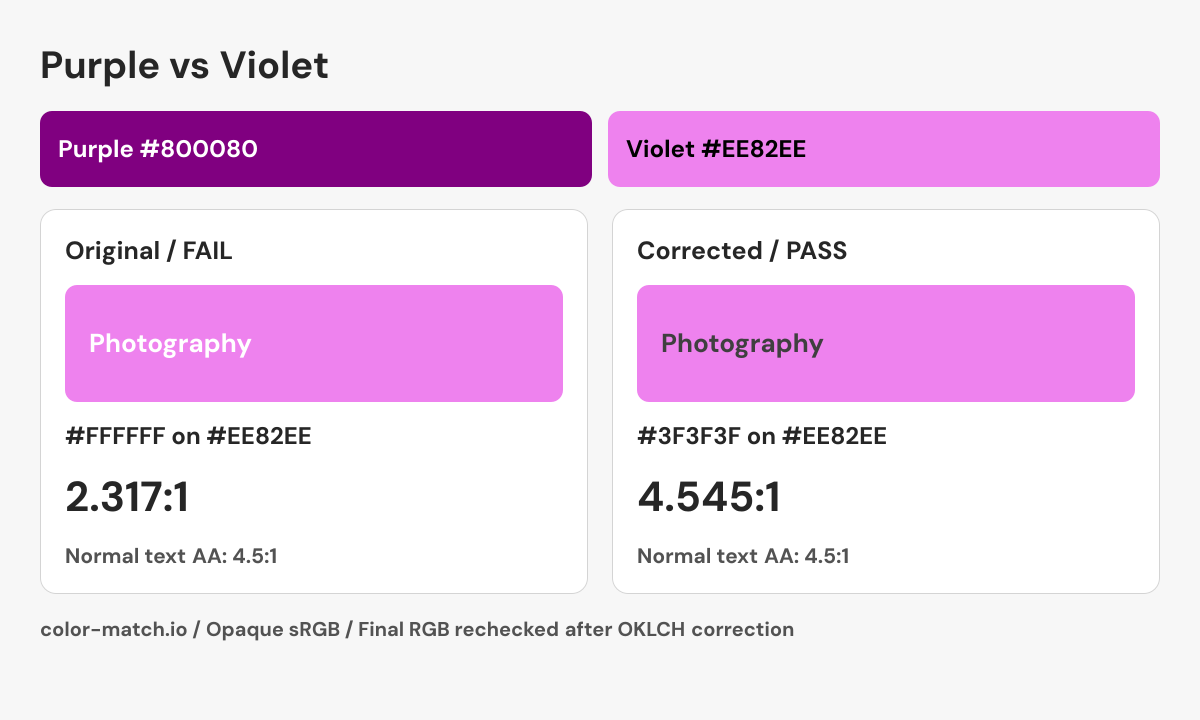
A filter chip uses CSS violet as its fill and a normal-size “Photography” label. A white label and a purple label produce different outcomes on that same fill.
2.317:1 — Fail normal text AA
Violet is too light for this normal-size white label.
Check #FFFFFF on #EE82EE4.065:1 — Fail normal text AA
The darker CSS purple label is a useful alternative on the original violet fill.
Check #800080 on #EE82EEKeep the violet fill and choose a darker label. The computed neutral correction below preserves the original white label’s zero chroma; CSS purple offers another checked option with a different visual character. Neither is a substitute for showing which filter is selected.
A correction you can reproduce
Change the foreground while keeping the background fixed. The OKLCH search returns a nearby passing candidate, then measures the final six-digit sRGB colors again. It does not guarantee the mathematically nearest color.
- Original pair
- #FFFFFF on #EE82EE
- 2.317:1 — Fail normal text AA
- Corrected pair
- #3F3F3F on #EE82EE
- 4.545:1 — Pass normal text AA
.example-label {
  color: #3F3F3F;
  background-color: #EE82EE;
}
This snippet contains the checked color pair. Apply the non-color checks below when building the real component.

Checks beyond the color pair
- Use a checkmark and aria-pressed when the chip toggles a filter.
- Keep the label present after selection.
- Test the focus ring and target size in the actual filter row.
Why CSS violet looks pinker than expected
Both swatches have equal red and blue RGB channels, but violet also contains a substantial green channel and is lighter overall. CSS color names are established keyword assignments, not a carefully spaced scientific classification of every hue. A color called violet in a flower guide, pigment range, or physics discussion may therefore look different from the CSS swatch. Use the exact value when a name could be interpreted in more than one way.
How to combine purple and violet
Try the darker purple as a heading or compact accent and the lighter violet as an illustration fill or broad decorative area. Evaluate the pairing before putting purple text directly on violet: an attractive difference in the swatches does not settle the text requirement. For a lighter reading surface, a pale tint may be more useful than the named violet itself. Open either color to inspect tints and shades while retaining the original reference.
Screen color, spectral color, and printing
A HEX value specifies an sRGB triplet rather than a light spectrum. An RGB display produces the appearance using its primaries, so a screen preview cannot demonstrate whether a physical source emits a single wavelength or a mixture. Similarly, converting this triplet to unprofiled CMYK does not specify a dependable printing recipe. For this guide, conclusions concern the displayed CSS references and their computed text contrast; physical color reproduction requires its own measured workflow.
Sources and calculation method
CSS keyword values follow the W3C named-color table. A reference described as selected is an editorial swatch. Contrast is calculated from these exact values using WCAG relative luminance.